
Table of Contents
- Best Background Check for Property Managers: Quick Comparison
- 1. MacData: One System for Tenant Screening and Fingerprinting
- 2. Avail, RentPrep, and RentSpree: Reports Built for Smaller Portfolios
- 3. Property Matrix, TenantAlert, and DoorLoop: Screening Inside Property Management Software
- 4. SmartMove, TenantCloud, and SingleKey: Applicant-Paid and Self-Service Options
- Criminal Background Check for Tenants: What the Report Covers
- Tenant Screening Cost: What Drives the Price
- Tenant Screening Criteria: Setting Fair, Consistent Standards
- Frequently Asked Questions
Last Updated: October 5, 2026
Best Background Check for Property Managers: Quick Comparison
The best background check for property managers balances speed, coverage, and FCRA compliance without locking you into a vendor that only serves enterprise portfolios. This guide from MacData compares tenant screening services across features, pricing, and fit for smaller operators.
Tenant screening is the process of verifying a rental applicant’s identity, income, rental history, credit profile, and public records before you sign a lease. Get it right and you fill units with reliable renters. Get it sloppy and you inherit eviction costs, property damage, and fair housing exposure.
Most guides to the best background check for property managers rank services by brand recognition. That misses the point. The right provider depends on your portfolio size, whether you screen in one state or several, and how much of the report you want a human to review. Below, we break down the field and show where each option actually fits.

How We Evaluated the Top Tenant Screening Services
We scored each service on four things: what the screening report actually covers, how fast results come back, how pricing is structured, and how well it fits a working leasing workflow. Report accuracy and dispute handling carried extra weight, because a wrong record match can cost you an applicant and a legal complaint.
We also weighed applicant experience. A screening service that confuses renters slows your leasing cycle and invites disputes. The Fair Credit Reporting Act guidance from the Consumer Financial Protection Bureau sets the compliance floor for every provider here, so consent, disclosure, and adverse action notices must be handled correctly.
Feature and Pricing Comparison Table
| Service | Best For | Standout Feature | Pricing |
|---|---|---|---|
| MacData | Full-service screening and fingerprinting | One system for tenant and employment checks | Quote-based |
| Avail | Multi-record reports | Criminal, eviction, liens, SSN verification | Not published |
| RentPrep | Unclear results | Human review of gaps | Not published |
| RentSpree | Agents and small firms | Fits agent workflows | Not published |
| Property Matrix | PM software users | Screening inside a PMS | Not published |
| TenantAlert | Landlord screening | Roundup-listed option | Not published |
| DoorLoop | Software-first operators | Screening within DoorLoop | Not published |
| SmartMove | Applicant-paid screening | Landlord-focused reports | Not published |
| TenantCloud | Budget screening | Standard Screening at $39.99 | $39.99 per screen |
| SingleKey | Cost research | Report cost guidance | Reports often $20-$40 |
1. MacData: One System for Tenant Screening and Fingerprinting
MacData is a strong option for property managers who want tenant screening and fingerprinting handled through one system. We are locally owned and operated, with over a decade of experience running FCRA-compliant checks for landlords and employers. That matters when you screen applicants across multiple states and need consistent documentation.
What sets us apart is consolidation. MacData runs tenant background checks, pre-employment screening, and Livescan digital fingerprinting through one easy-to-use system. You get fast, secure reporting and rapid turnaround times.
If you screen tenants and also hire staff, running both through one provider cuts duplicate data entry and keeps your FCRA compliance trail in one place.
2. Avail, RentPrep, and RentSpree: Reports Built for Smaller Portfolios
These three show up in nearly every landlord screening roundup, but they solve different problems. The right pick depends on whether you want breadth of records, a human in the loop, or a workflow that already matches how your team leases.
Avail is built for the self-managing landlord who wants one report covering multiple record types. Its screening pulls criminal records, sex offender registries, eviction history, judgments, liens, and SSN verification into a single pass. That breadth is the selling point: you review one document instead of stitching together three. The trade-off is that breadth is not the same as depth.
RentPrep earns its place for a different reason: human review. When a result comes back unclear or incomplete, a common-name match, a sealed record, a gap in employment history, RentPrep offers human assistance to interpret it. That matters because data gaps, not missing databases, are the leading cause of bad screening decisions.
RentSpree fits real estate agents and small property-management firms. It slots into agent workflows rather than forcing a new process, which shortens the learning curve for teams already working out of a CRM. For a manager running a handful of doors alongside sales activity, that integration is worth more than an extra database.
A pattern worth noting across all three: pricing is usually applicant-paid and quoted at the point of application rather than published as a flat rate. That keeps your per-unit cost near zero but shifts friction to the renter. If your market is competitive and applicants are comparing fees across properties, an applicant-paid model can cost you good renters before you ever see their file.
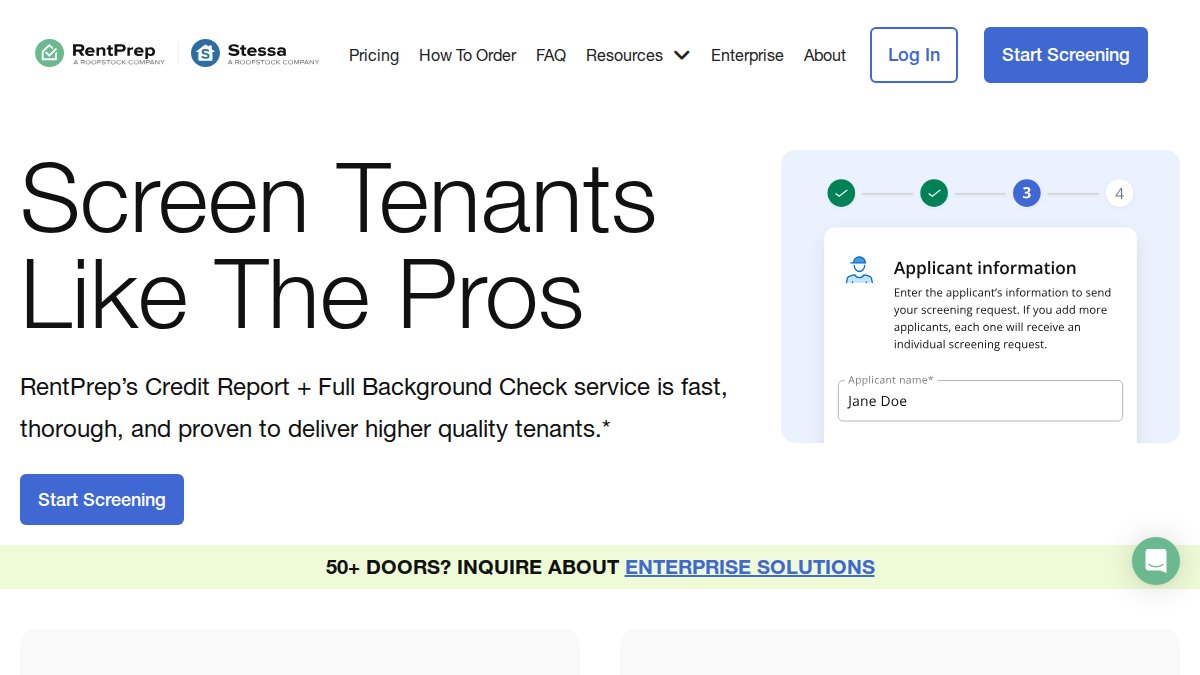
For a small portfolio, pick on the axis that actually hurts you: record breadth (Avail), human review of ambiguous results (RentPrep), or workflow fit (RentSpree). Do not pick on brand recognition.
3. Property Matrix, TenantAlert, and DoorLoop: Screening Inside Property Management Software
Property Matrix, TenantAlert, and DoorLoop all appear in landlord screening roundups, and each is built for operators who want screening inside their property management software. The appeal is obvious: one login, one applicant record, no copy-pasting between systems.
Where PMS-embedded screening wins. When screening is native to your leasing system, the applicant record, the report, and the decision all live in one place. That matters for team permissions: you can give a leasing agent the ability to send an application without giving them the ability to see credit details, and you can give a regional manager read access across properties without handing over admin rights.
Where it costs you. When screening lives inside a PMS, you inherit that platform’s coverage and turnaround. If your portfolio spans several states with different record availability, and most do, a dedicated consumer reporting agency often gives you more control over what the report includes and how fast it comes back. The other hidden cost is data handling.
What to ask before you commit. Which databases does the provider actually search, and in which jurisdictions? What is the stated turnaround time, and does it hold for county courthouse searches or only for instant database hits? Can you export the report and the adverse action notice for your records? Can you set different screening packages per property, or are you locked into one?
The compliance angle most roundups skip. Screening rules are not uniform. Some jurisdictions restrict how far back you can consider criminal history, some limit the use of eviction records, and some regulate whether and how much you can charge an applicant for a screening fee.
Screening built into a PMS can hide what the report actually covers. Ask which databases the provider searches, how long results take, and how the system handles jurisdiction-specific rules before you assume two reports are equivalent.
If you manage a portfolio across multiple states, run a short pilot: screen one applicant at each property through the embedded tool and compare the reports side by side. Differences in coverage and turnaround show up fast.
4. SmartMove, TenantCloud, and SingleKey: Applicant-Paid and Self-Service Options
SmartMove is built around applicant-paid screening, which shifts the fee off your books. TenantCloud publishes a Standard Screening price of $39.99 and reports a 14-day free period, making it a straightforward budget option.
Applicant-paid models reduce your cost per unit but add friction: some renters balk at paying, and a slow payment stalls your leasing workflow. Self-service options work best when your applicant pool is comfortable with online screening and you have clear application criteria posted up front.
Criminal Background Check for Tenants: What the Report Covers
A criminal background check for tenants searches public records, criminal registries, and sex offender databases, then matches results to your applicant’s identity. The report itself is only as good as its database coverage and record matching.
Credit, Eviction, and Identity Verification
A complete screening report pulls several threads together:
- Credit report and credit history: payment patterns, collections, and outstanding balances
- Eviction history: prior eviction records and landlord-tenant filings
- Identity verification: SSN verification and address history
- Income and employment verification: pay stubs, employer confirmation, or bank records
- Criminal records: county, state, and federal searches where available
Record accuracy is where reports fail. Common names and outdated public records produce false matches, which is why human review and a clear dispute process matter. Applicants have the right to dispute inaccurate information under the FCRA dispute process outlined by the Federal Trade Commission.
Tenant Screening Cost: What Drives the Price
Tenant screening cost depends on how many databases a report searches, whether a human reviews it, and who pays the fee. Simple credit-and-eviction reports sit at the low end. Reports with criminal history, income verification, and identity checks cost more because they pull from more sources.
TenantCloud lists Standard Screening at $39.99. At portfolio scale, the bigger cost is not the per-report fee. It is the vacancy days lost to a slow turnaround and the eviction costs you avoid by screening well.
Track your true cost per screen by adding the report fee to the staff time spent reviewing it. A cheaper report that takes twice as long to interpret is rarely the cheaper option.
Tenant Screening Criteria: Setting Fair, Consistent Standards
Tenant screening criteria are the written standards you apply to every applicant, and they must be applied the same way each time. Fair housing law prohibits discrimination on protected grounds, so your criteria must be objective and documented. State and local rules vary, and some jurisdictions restrict how far back you can consider certain records.
Write your criteria down before you advertise the unit. A common approach is to set a minimum credit threshold, a rent-to-income ratio, and a defined lookback period for criminal and eviction records. Then apply it without exception.
- Minimum credit score or credit history standard
- Rent-to-income ratio, such as rent not exceeding a set share of monthly income
- Defined lookback window for eviction records
- Defined lookback window for criminal records, per local rules
- Required income documents and verification method
- Written adverse action process for denials
Consistency protects you twice: it keeps decisions defensible, and it makes your leasing process faster because applicants know what to expect.
Screening tenants well takes more than picking a vendor. It takes consistent criteria, accurate reports, and a process your team can run without guesswork. MacData handles tenant screening, pre-employment checks, and Livescan fingerprinting through one easy-to-use system, with FCRA-compliant reporting and rapid turnaround times. If you manage a portfolio and want screening you can trust, book an appointment with MacData and build a leasing process that protects your properties from the first application.
Frequently Asked Questions
What is the best background check service for property managers?
The best background check for property managers depends on portfolio size and workflow. MacData offers one system for tenant screening, pre-employment checks, and Livescan fingerprinting with FCRA compliance built in.
What should a tenant background check include?
A complete tenant background check should include a credit report and credit history, criminal records and criminal registries, eviction history and eviction records, identity verification, and income or employment verification.
How do property managers check a tenant’s criminal record?
Property managers run a criminal background check for tenants through a consumer reporting agency, which searches public records and criminal registries at the county, state, and federal level. Database coverage varies by provider, so confirm which jurisdictions are included. Under the Fair Credit Reporting Act, you must obtain applicant consent and send an adverse action notice if you deny based on the report.
How much does tenant screening cost?
Tenant screening cost varies by provider and report depth. TenantCloud lists its Standard Screening at $39.99 with a 14-day free period. MacData does not publish flat rates because pricing depends on volume, report type, and turnaround needs. Request a quote for your portfolio size, and confirm whether the applicant or the property manager pays the screening fee.
What should property managers do if they deny an applicant based on a background check?
If you deny an applicant based on a consumer report, the Fair Credit Reporting Act requires an adverse action notice. Provide the name of the consumer reporting agency, state that the agency did not make the decision, and explain the applicant’s right to dispute inaccurate information. Apply the same tenant screening criteria to every applicant so your rental decision stays consistent and defensible under fair housing rules.